Aircraft Wing Structural Analysis
Structures · ERAU
Role
Individual — CAD Modeling & FEA Simulation
Structures · ERAU
Tools
Fusion 360 · FEMAP · NX Nastran
Key Contributions
- Modeled full wing assembly including spars, ribs, stringers, and skin panels in Fusion 360
- Transferred geometry to FEMAP and solved with NX Nastran under distributed aerodynamic loading
- Validated mesh quality with Jacobian values above 0.6 across all elements
- Interpreted stress and displacement contours to confirm structural adequacy and identify load paths
This page covers a full structural analysis workflow for an aircraft wing — from 3D CAD assembly in Fusion 360 through finite element analysis in FEMAP and NX Nastran — ending with stress and displacement results that confirm the wing's structural adequacy under flight loading.
Project Overview
Structural analysis of an aircraft wing under aerodynamic loading is one of the most fundamental tasks in aerospace engineering design. This project covered the complete workflow from 3D CAD geometry creation through finite element analysis, with the goal of assessing stress distribution and deflection behavior under realistic flight loads.
The wing assembly was modeled in Fusion 360 with all primary structural members included, then transferred to FEMAP for preprocessing — where loads and boundary conditions were applied and the mesh was generated and validated — before solving with NX Nastran.
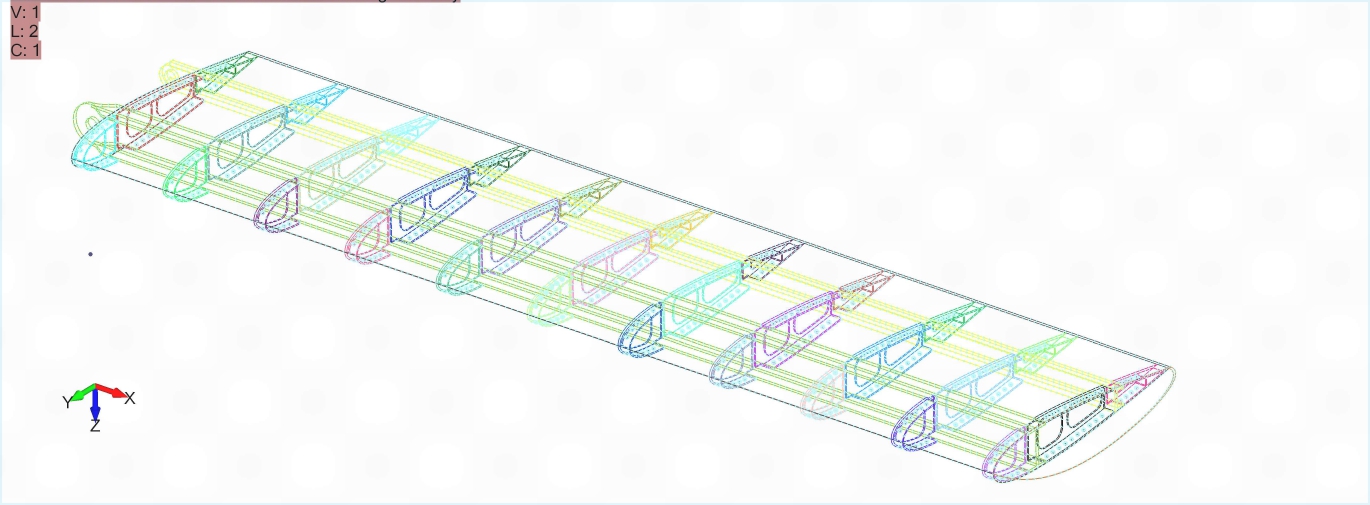
- CAD assembly: full wing model with front and rear spars, ribs at regular spanwise stations, longitudinal stringers, and upper and lower skin panels
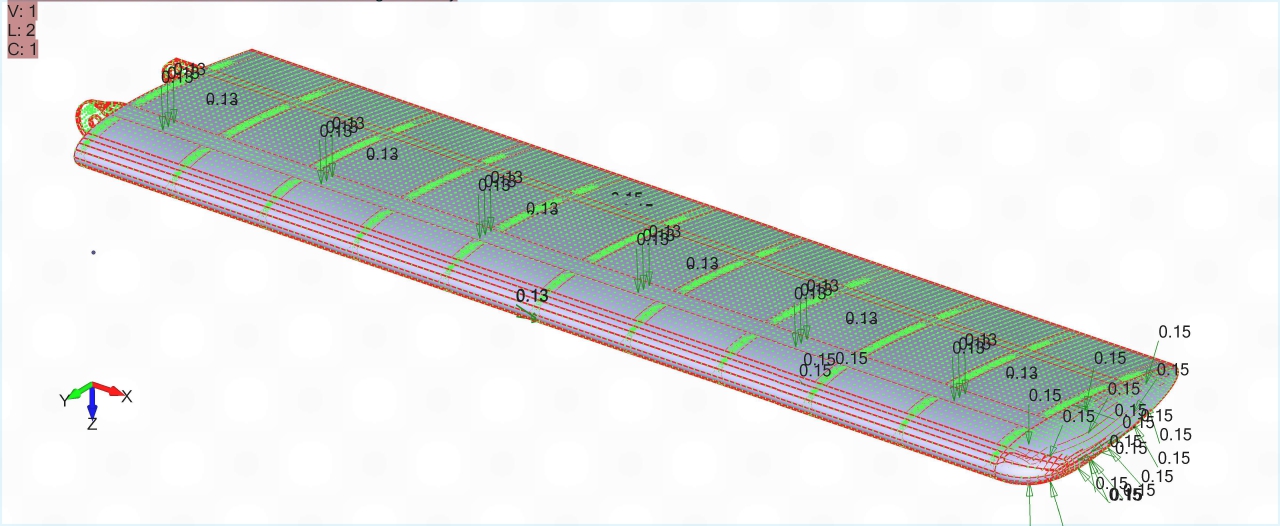
- Loading & boundary conditions: distributed aerodynamic loads applied in FEMAP, with the wing root set as a fixed boundary condition
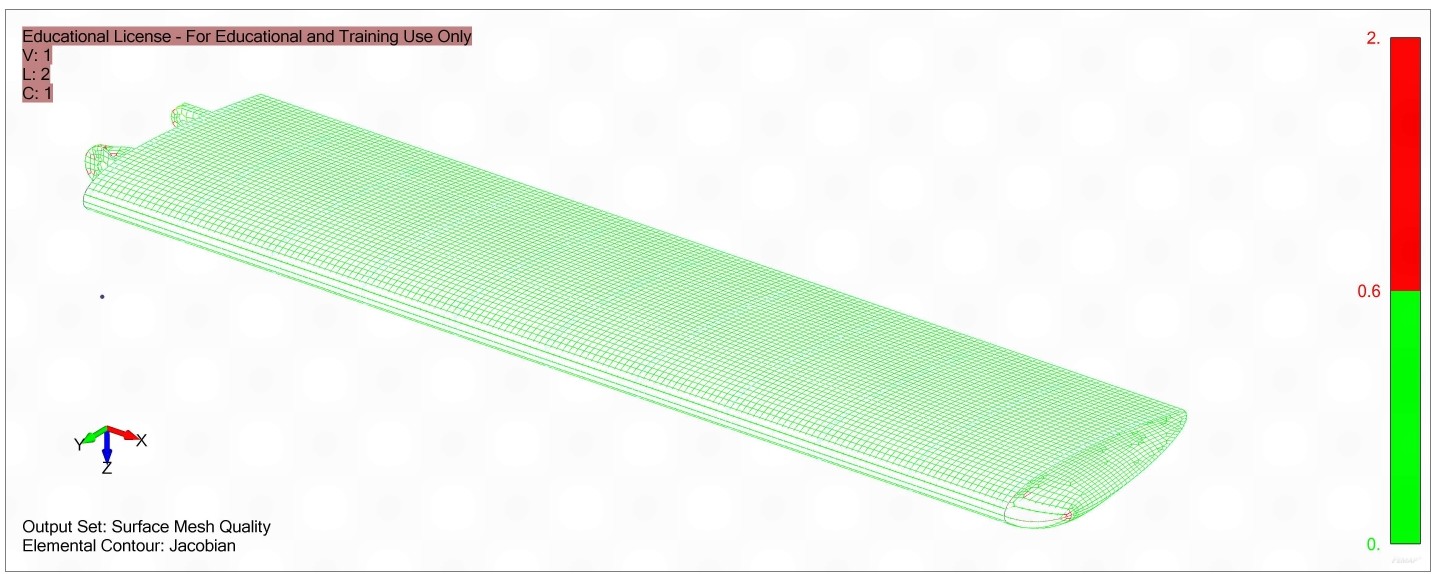
- Mesh validation: finite element mesh generated and checked for Jacobian quality above 0.6
- Solution & interpretation: solved with NX Nastran, then von Mises stress and displacement contours interpreted to confirm structural adequacy and identify load paths
CAD Geometry & Assembly
The wing was modeled as a full structural assembly rather than a simplified shell, capturing the load-carrying behavior of each member:
- Front and rear spars — run the full span and carry the majority of bending loads
- Ribs — positioned at regular spanwise intervals, maintaining the airfoil cross-section and transferring aerodynamic loads into the spars
- Longitudinal stringers — placed between ribs to provide additional bending stiffness and reduce skin panel buckling
- Skin panels — close out the structure and carry shear flow
Particular attention was paid to interface geometry between components, ensuring that mating surfaces were flush and that no gaps or overlaps would cause meshing artifacts during FEA preprocessing. The assembly was exported in a format compatible with FEMAP for direct geometry import without manual reconstruction.
Finite Element Analysis
- Loading: a distributed aerodynamic pressure load was applied to the upper and lower skin surfaces to simulate lift loading in steady level flight
- Boundary conditions: the wing root was fully constrained as a fixed boundary condition
- Mesh: generated using shell elements for skin panels and beam elements for spar and stringer members, with refinement applied at high-stress locations near the root and spar caps
- Mesh quality: all elements achieved Jacobian values above 0.6, confirming element distortion was within acceptable limits for Nastran’s linear static solver
Design Decision
Trade-off: Modeled the skin panels with shell elements and the spars and stringers with beam elements, rather than meshing the entire assembly with solid (3D) elements.
Why: The skin is thin relative to its planar dimensions, and the spar/stringer caps are long, slender members — both are well-represented by 1D/2D idealizations without the element-count explosion a solid mesh would require. This kept the model small enough to refine locally near the spar root, where the stress gradient is steepest, while still resolving the load paths (bending in the spars, shear flow in the skin) that the analysis was meant to capture.
Key results from the NX Nastran solution:
- Peak tip displacement of approximately 0.15 inches — within acceptable deformation limits for the loading scenario
- Highest von Mises stresses concentrated at the front spar root, consistent with expected bending moment distribution
- Skin panel stress levels were lower than spar cap stresses, confirming the spars carry the dominant bending load
- No stress concentrations from meshing artifacts, confirming adequate geometry cleanup during preprocessing
Key Takeaways
CAD quality directly controls FEA validity
Interface gaps or overlapping surfaces in the Fusion 360 model cause meshing failures or poor Jacobian values in FEMAP. Cleaning geometry before export eliminated all preprocessing issues and allowed the mesh to be generated without manual repair.
Spars dominate bending load paths
The von Mises contour confirmed that front spar root stresses were significantly higher than skin panel stresses. In a cantilever wing, the spars carry the majority of bending moment and shear, with skin panels primarily carrying torsional shear flow.
Mesh refinement at stress risers improves solution accuracy
Applying local mesh refinement near the spar root and spar cap intersections captured the stress gradient more accurately than a uniform mesh. This prevents artificially smooth contours from obscuring genuine stress concentrations in high-load regions.
Jacobian validation is a necessary pre-solve check
Reviewing Jacobian values before submitting to Nastran caught distorted elements near rib cutouts that would have degraded solution quality. Re-meshing those regions resolved the issue. Relying only on visual mesh inspection is insufficient for production FEA work.